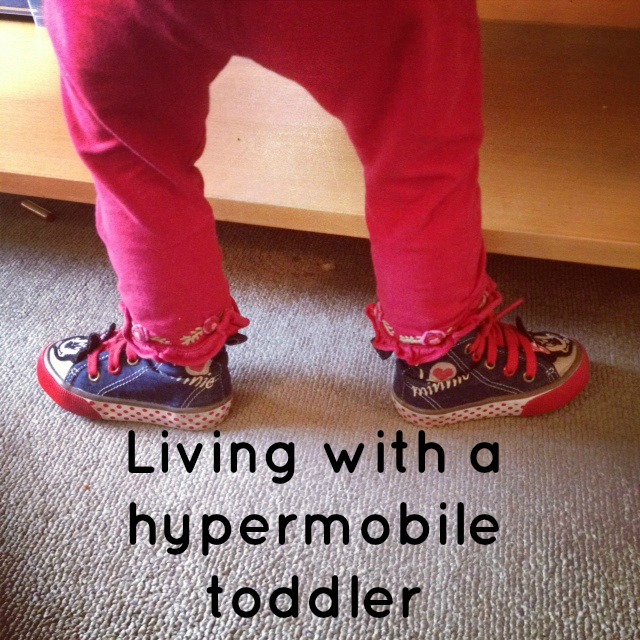
 This time last year I was panicking about the fact my 19 month old wasn’t walking. At all. After a referral to the hospital for a potential issue with her hips and feet, we were given a bit more of an explanation. At the time, the specialist we saw explained she was “too bendy“. Now, that “too bendy” has been put into a word I’m very familiar with: hypermobility. I am living with a hypermobile toddler.
The picture above was taken around a year ago. Frog’s feet naturally fell at right angles to her body. Her ankle joints were so flexible that her feet caved in, so she was trying to balance on the side of each foot. It’s not surprising she couldn’t stand up on her own.
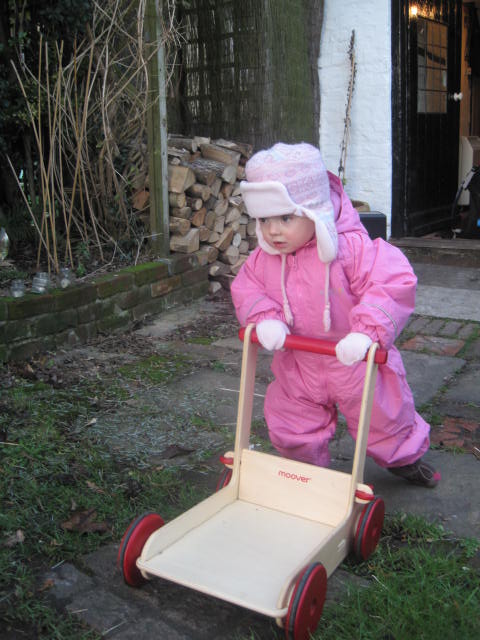 At the time, it was heartbreaking to see my determined tot trying to catch up with her peers. She visibly withdrew into herself because she couldn’t join in with the games of the other toddlers running around her. People often assumed she had developmental issues or was at least eight months younger than she was. I was angry a lot of the time and became an expert at biting my tongue.
We had three months to wait for an appointment between our initial GP visit and our referral. Once we’d had our referral at the hospital, we had another two months to wait for the first physiotherapist session. By that time, my daughter was almost two years old – and still not walking.
Looking back, the six months between January to June last year were ones of constant frustration. I was a frustrated mum, battling to get information and find a cause to something I KNEW had a cause. Every day saw me bat away well meant advice from other parents whose children “hadn’t walked until they were two” etc. Although these words were meant as a kindness, in my paranoid, ill informed state, I assumed they were trying to tell me nothing was the matter. I knew something was the matter though – just not exactly what.
A year on, and we are smiling. Our toddler eventually got up on her feet and walked all by herself just before her second birthday. She was given special boots (like Piedro boots, but a different brand) just after this, to help strengthen her knees and hips. These boots did the job her ankles were supposed to be doing, helping her gain in confidence.
Once she was properly, confidently up and about, the boots were ditched. We put Frog in hi-top trainers which supported the ankle, or boots from Next. Clarkes were no good, as she wasn’t deemed “ready” for the “big girl shoes” but the soft soled ones provided no support to her ankles. Equally, her tiny feet were too small for the boots recommended to us – Kickers or Timberland. So we opted for a brand called Ricosta. They were perfect at the time.
 While I worried about her future footwear and the inevitable battles we’d have over high heels, I was relieved to see my daughter finally blossom into the little girl I knew at home; confident, chatty and playful. The panic in new situations and her habit of covering her face and whispering “scared” stopped almost as soon as the walking started.
Then came October and a final physio appointment, in which we were signed off, with the warning to come back if Frog complained of pain at any point down the line. And we had an orthotics appointment in December, which saw my two and a half year old issued with special hospital issue insoles, to support her ankles and give an arch to her foot which is completely lacking. This means she can finally wear “big girl” shoes.
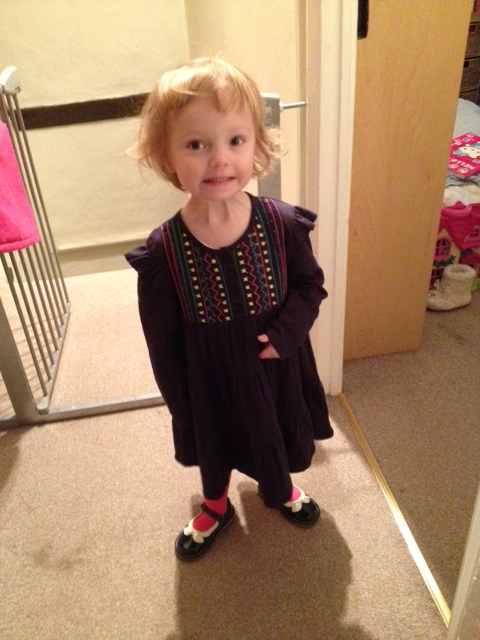 Today, we received a letter from the Paediatric Orthopaedic clinic at the hospital. It was following up our most recent check up, just over a week ago, confirming that we won’t need to go back. Another department has officially signed my daughter off, stating a “marked improvement” and noticing she is now “walking with an entirely normal gait”. Now it’s just the orthotics team we need to keep seeing, who’ll evaluate her progress with the insoles.
Last year was a tough one. We didn’t know what we were dealing with and there were times when it felt like there’d never be a moment when I’d see my toddler stand up and walk on her own. She has hypermobile joints, possibly hypermobility syndrome. Her joints are so bendy that we’ve been warned it’s unlikely the issue will ever just go away. Although it might.
That’s the thing with hypermobility. You just don’t know. Doctors are hesitant to diagnose hypermobility syndrome until a child complains of joint pain and fatigue. We have the fatigue, but Frog isn’t yet old enough to tell us if her joints actually hurt. All we know is that an active day or a morning at nursery needs to be followed by a rest, or she’ll ask for Calpol and end up sleeping as much as 15 or 16 hours the following the night. As nice as that is for parents who enjoy a lie-in, we’re aware it’s not “normal”.
During the past 12 months I’ve learned lots; how to trust my child, how to be patient, where to search for information and how to shout if I need to. I’ve written articles about what it’s like to be the mum of a toddler with hypermobility and I’ve given a presentation to a room of students training in childcare.
My answer is always the same: it’s not easy, but you get there. You get there, because you have to.
If your child has recently been diagnosed with hypermobility, please know that it WILL get better. There IS light at the end of the non-walking tunnel, however far off it may seem.
And if you need any more information, you’d do well to contact the Hypermobility Syndrome Association.
Hello Molly
Just found your blog, my mum found it and told me about it.
Finally got myself diagnosed at the age of 28 (just so the doctors couldn’t knock my suspicions of my daughter having it) and my daughter diagnosed at 18 months, had a referral.
All I have been told by the physio so far is get her boots that come up high and take her swimming.
Done lots of research myself.
I’ll be following this blog and reading up on past blogs regarding Frog and how she’s been getting on.
People like yourself are a Godsend.
Many thanks
Lorraine.
Hi, I know this an old post but came across it when searching for information on hypermobile toddlers. What a wonderful post that has made me feel we’re not alone with our little boy! He is 16 months and recently got his Piedro boots (lucky that we have them early I think!). He is a happy, cheeky boy most of the time but is becoming increasingly frustrated at not being able to walk himself (particularly as he has a 3.5 year old brother who loves playing outside). I too am finding the whole thing quite heartbreaking, despite him still being very young. I just know he would be toddling around with his peers if it weren’t for his bendy ankles. Anyway, he is doing brilliantly walking with his pusher (similar to the one your little girl is pushing in her snowsuit!). Just wondering, know it was a while ago, but do you have any tips/activities to help him start to stand unaided and take those first independent steps? I know he will do it in his own time, just keen to help wherever possible. I hope your little girl continues to thrive – thank you again for writing this xx
I was just diagnosed with hEDS (Ehlers Danlos Syndrome, hypermobility type, for anyone reading that may not know), so my chances of having a child without EDS of any kind are 50/50 or worse. And it’s kept me up at night innumerable times. I’m slowly coming to terms with it, and I’ve decided to have a child as a single mother (I’ve always been a stickler that I don’t need a partner to raise a child, and I’m a grey-asexual on top of it, but my rainbow zebra story is a different story).
Reading this… brought me to tears. It gives me hope. Hope that I can handle what my child may develop as they grow. Hope that I’m not alone, and won’t be alone if I end up going through this. And hope that other parents out there will find this and understand that their children are different, but not broken, and certainly not deficient in any way.
So thank you.
My 13 months old daughter,recently has been diagnosed with hypermobility and hypotonia.I do not know much yet about this. I am so scared !!!!Thank you for sharing your experience.
Don’t be scared! My little girl is now 7 (today) and you would never guess all the challenges she overcame to learn to walk. I think it made her a more determined little thing too. x
Hi Molly. My 22 month old has recently been diagnosed with hyermobility and reading this has really helped me so thank you.
I knew something was wrong as she wasn’t as ‘up to speed’ as the other babies her age and others much younger.
She’s started walking with a walker now and walking holding onto the wall so fingers crossed she gets there soon.
I’ve been told she may not talk until she’s at least 3 as shes only saying a couple of words, so it’s nice to know I’m not alone and other parents have gone through the same thing and it does get better. Thank you xxx
You’re definitely not alone Leanne, and it DOES get better and easier, I promise. x
Thank you molly you have no idea what this article has done to me, I was living my worst night mare during last 8 months sine my daughter first birthday. The doctors did not give any information and keep saying she will be fine, I read each and every article and I dioginze my daughter and when I ask the doctor she said may with no explanation. It was tough I am really thankful, you cant imagine how you article create a hope to me. I have one question about talking does your cute angle speak well, and does she facing any learning difficulties ? are our kids can grow normal ?
These questions will make me crazy, and no clear answers
Thank you again
Hi Pearla, thank you for your comment and I’m glad this post has been helpful for you. In our situation, our daughter had no difficulties other than learning to walk. She was actually a pretty early speaker (comparatively to her very active baby sister who started to walk at 12 months and was crawling by 6 months!). So no, there were no learning difficulties. However, I’d say keep going to see your doctor and push for a referral to a specialist if you can. I’m not sure whereabouts in the world you’re based, but hopefully there will be physiotherapists and peadiatricians who are able to offer some support. I hope you get some answers soon.
I feel like I finally found someone that can relate to me and the struggle my daughter is having with walking! She also has feet that point almost at a right angle and walks on her ankles. Her pediatrician is stumped and never mentioned hyper mobility. We are waiting on a call from the pediatric orthopedic doctor and my little girl starts physical therapy on Monday. She will be 18 months old in 2 weeks and can’t even stand without support. When she does pull up and cruise she will only do it for a few minutes at a time which may be the fatigue you talked about. I’m definitely going to bring this up to the orthopedic doctor and see what she thinks. I’ve googled so many times and couldn’t find exactly what I was looking for until I found your blog. Thank you!!
Hi Niki, I hope you get some answers soon. I know how hard it is to see your little one wanting to walk but not being able to. I’m glad you’re getting support though and hope that the experts can offer you some useful advice and information soon.
Reading this is like reading my life right now. My daughter is 2 next month and has hypermobililty. She didn’t crawl until 20 months and will now cruise around holding onto hands/furniture. I was crying last night as I was hoping she would be walking by the time she was 2 and that is in 3 weeks so I’m not very hopeful that!
Can i ask what boots you found were best? was is the Ricosta ones? she hates all the shoes/boots i put her in but i know they are the key to her walking.
Thanks again
Hi Emma, yes we found the Ricoste ones were great. We bought ours online as couldn’t find any in a store anywhere but they were fantastic. Ultimately though, she was given piedro boots from the hospital once her physio started. They made a huge difference, even though she didn’t actually end up wearing them for very long.
emma, just wondering how your little one is doing. This blog was like taking the blindfolds off my eyes. Molly was a God’s send.
Thank you so much for writing this my daughter has just been diagnosed as having hypermobility I feel a bit lost and upset as to what this will mean for her but she is doing great climbing stairs and pulling herself up and cruising the furniture so I hope one day she just takes off we have moved to a whole new town so we are awaiting physio again I think the day she walks will be my version of winning the lottery I am just feeling a bit lost atm so thank you again your article brings me reassurance that I so desperately need atm xo
It will happen in the end, I’m sure of it! And I’m sure you’ll be impressed by her determination. x
So nice to read your posts, my 23 month found out she was double jointed everywhere so was preventing her walking, I have just cried to the NHS as after a month we had no physio appointment, well with tears I have one for next week. I can see it is effecting her confidence and she is the only one in nursery who can not walk and she gets very frustrated which I can understand.
We now have the appoinment to look forward to and I am hoping will not be too long before my little one can explore but your post gave me hope so thank you.
Thank you again and to everyone else going through this Good luck, it is hard work as a parent trying to fight for the right treatment for our little angels 🙂
So pleased you’re getting that physio appointment – it will help tremendously. Thank you for your lovely comment.
How lovely to stumble across your blog. I have a 21 month old with hypermobility. I totally am at the frustrated stage, as is she! We’re going for the boot fitting/appointment this week. Great blog. Thank you!
Thank you for the kind words – I can totally relate to the frustration! It does get better though, I promise. The boots will be brilliant – we found they made a huge difference.
So glad I found this my little man is 19 months and I’m currently having the same issues.
Hopefully see a physio soon and get him up and moving. ????
Great news you’re seeing a physio – we found the physio was our first step to walking. I’ll have everything crossed for you.
Great post Molly. My daughter was diagnosed eith hypermobility and hip dysplasia @ 9 months old. She is now 19 months old, cant stand or walk unaided, her both feet turn completely outwards, and also she is dragging her right foot/leg. I have had two ortho appointments, but nothing is getting done, I’ve been told nothing or given nothing to help her at all. I am now at my wits end , I’ve been hounding the hospital and still nothing. Would anyone have any advice please.
Extremely worried mammy
Definitely get in touch with the charities STEPS and The Hypermobility Syndrome Association (HMSA) as they will be able to give you solid advice about where to go for guidance. I’d also recommend checking out my friends Emma’s blog at http://www.emmaand3.com. Emma’s little girl had hip dysplasia and it’s a subject Emma has written about extensively on her blog. x
Hi. We have a nearly 1year old who is still having regular physio appointments and as yet is not signed off from Hospital. When Jack was born he caught Group B Strep, breathed Meconium, low blood pressure ans Septicaemia. He was very ill and nearly didn’t make 24hours. He stayed in Critical then Intensive care and finaly Special Care for 3weeks. It was the most terrifying time of our lives.
Since then, Jack has had physio every month and now been told he has very bendy joints. Next month if he still isn’t walking we will be referred to look into those special boots. Jack can roll back and forth and can sit upright if I put him into that position but he just can’t pull himself up. It’s really upsetting to think he may not walk but I’m given hope by your story. Thank you, reading your story has (made me cry a little) but has given me a bit of hope X
Thank you for this encouragement. My son has just turned 2 and is still not walking. He is hypermobile and a bottom shuffler. We are being seen by physios. He’ll walk holding onto my fingers but will not cruise with furniture and doesn’t climb. Support boots were mentioned initially but never followed up on so think I will chase this. He has no stability around his hips and looks like pinnochio learning to walk!It’s breaking my heart everyday now and the frustration is unbelievable all round. So nice to see that there can be light at the end of what seems like a never ending tunnel….
There really is light at the end of the tunnel – although it may not feel like it to start off with. We found the support boots incredibly helpful. Even now, aged four, she still wears special insoles in her shoes and probably will need them for the rest of her life. But other than that you wouldn’t really know her struggles with walking just a couple of years ago. Your son will get there in the end – he’ll show you his determination, have faith and know that you’ll probably cry when you see him take those first unaided steps! x
I came across your post. My son is almost 19 months and not walking. He had numerous colds etc and on a gp apt they found a heart murmur, after heart scan two tiny holes were found but these won to pact his life at all, thank god. At the same I raised my concerns at him not walking and we have been referred To a paedatrician. He is having a cpk blood test tomorrow to rule out muscular dystrophy. I am of course very worried. They have said he is hypermobile, can put his foot in his mouth his balance also even sitting or crawling is also off, he falls frequently. He met all his early milestones, was sitting at 5 months & crawling at 8 months. He has never bum shuffled. His development has slowed down a bit I think. I’m hoping it is only hyper mobility than anything more serious. Although it seems hyper mobile children still struggle. He has never been a great sleeper either and I now wonder whether he Is in pain. Thank you for your post.
Hi Claire, I’m so sorry to hear about your son’s struggles and your current fears. I will have everything crossed that it turns out to be a diagnosis of hypermobility and nothing more serious. Although hypermobile joints have meant my daughter has taken a little longer to reach her physical milestones now, at the age of 4 years old, she is doing very well and you would never know she has extra bendy joints!
It is so reassuring to know that we’re not on this road alone; thank you so much for sharing your story. My youngest son is 22 months and was only diagnosed as hypermobile at 19 months when he couldn’t stand, nor crawl! He can now stand and cruise furniture which is amazing but we’re currently at a stand still, which I’m happy to bare with for now….my main worry at the moment is his development in other areas, he certainly seems ‘behind’ but I am hoping that once he is walking it’ll all catch up? No one can really tell me. My other concern is we are currently living in Australia and attend physio every fortnight but we are about to move to the uk and I know we will be on the wait list again. I know we’ll get there, I just feel so bad for him….thank you again for sharing your beautiful daughters story, so reassuring 🙂
My daughter is 3.5 years old. She is hypermobile, especially distally, her ankle can bend upward well.over 60 degrees. But because she had not had many delays in her physical development, like your daughter, she crawled and walked at a relatively normal age. I was continuously denied that there was something “wrong” with her. After 6 months of insisting to her pediatrician there was something “not right” I was finally able to see a physio therapist who not only mentioned her hypermobility but also her low muscle tone.
She confirmed there was definitely something “not right” with my daughter. There was talk of bracing her particularly bad ankle, but ultimately we decided against it.
It is still a struggle to give her her independence while reminding her to be cautious, I don’t want her to NOT try new things for fear of falling or hurting herself but it’s certainly scary to watch your wobbly, rubber legged child climb up the thin metal ladder at the park!
She starts school September and I have many fears, her ability to keep up with her peers , being more tired and irritable, people picking on her or knocking her over ( because it’s so easy to do) needing extra help in class and taking away from the other r kids etc etc etc etc ……
it is nice to see others in similar situations
All your fears are very similar to my own. I’ve had chats with F’s new school (she’ll also be starting in September) about her need to build in rest times to her day and also the fact she falls over more often and struggles a bit with things like balance. They’ve been great, so I’d say it’s definitely worth chatting to the school about any worries. I think, ultimately, our kids can surprise us with their determination and ability to just get on with things – I know that’s been the case with F anyway!
Thanks for the article. Google search’s photo of your daughter brought me here…my son stands with ‘duck feet’ (out to the side) still at age 12, and we’re hoping ortho inserts will help him. I’m hypermobile, so I’m a frequent emergency room visitor due to lots of random accidents, but I was athletic and a dancer during my childhood-teen years- early adult years. They only thing I’d like to add is that you state: “People often assumed she had developmental issues or was at least eight months younger than she was. I was angry a lot of the time and became an expert at biting my tongue.” It sort of implies that having developmental issues is a bad thing. Of course we’d all like our kids to be healthy, but we share this planet with all sorts of people and they all need love and acceptance in the same way. If you’re unsure of how something sounds, replace ‘developmental issues’ with the racial minority of your choice and ask yourself if it would offend anyone– as people are usually hyper-aware of racial offenses and less so of those that are related to developmental delays. I worked with disabled children for ten years before I had my son, who has multiple profound disabilities. When people ask me if he’s mentally retarded or ‘messed up’, I just assure them that he’s simply extra cool– duck feet and all.
Hi there, thank you for taking the time to read my post and for your comment. I’m sorry you interpreted my comment as a slight against those with disabilities. It certainly wasn’t meant to be that way.
The point I was making was that people made assumptions about my daughter due to the fact she wasn’t walking and I found this frustrating at the time. I don’t condone prejudice in any form, which is something you would see if you read other posts on my blog.
I do feel that your interpretation of my comment is perhaps based on your own experiences rather than the way this post was written. Of course I would love my daughter and be just as proud of her regardless of ANYTHING – just as you are of your son. But I found it frustrating that people made immediate assumptions about her simply based on the fact she couldn’t walk. That doesn’t mean I think others who DO have developmental issues deserve any less love or acceptance than anyone else in the world. But the fact of the matter was that my daughter didn’t have developmental issues – people just assumed she did, because she couldn’t walk.
I’ve been very open and honest on this blog about my daughter’s condition in the hope it may help other parents who are going through similar things with their own children. I wouldn’t have been true to myself or to our situation if I had left out or glossed over the frustrations and upset I felt at the time. I’d like to reiterate that I don’t think “having developmental issues is a bad thing” as you have interpreted. It was merely a frustration at people perceiving my daughter in a particular way based solely on the fact that she couldn’t walk.
Thanks again for taking the time to comment.
I am so happy to have stumbled upon this and read of your beautiful daughter’s amazing progress. I too am going through what you went through a year ago right now and you have just described the feelings I have daily. My little girl is 26 months now and still not walking or standing independently nor able to stand to push a buggy etc. Tho she is showing progress it is very slow (will walk holding both my hands but her feet are so bent in its unbelievable). The battle of finding suitable shoes is ongoing and as yet Physio reluctant to give orthotics (tho I do not know why given her ankles almost touch the ground when bearing weight) I hope one day soon I get to write a similar post to this about my own daughter 🙂 Thanks for posting this and showing there is hope xxx
It does get better, honest! Just takes time and a lot of patience. x
Im so pleased I found your blog. My daughter is 19 months old and has just been diagnosed with having hypermobility. She can’t walk, stand or crawl and I was starting to think I would never see her get up on her feet. We are now waiting to get a physio appointment for her. It’s heartbreaking to see the frustration and being left out from play with the other kids…and of course people calling her a ‘lazy baby’. Your blog has given me so much hope., thank you 🙂 xx
Thank you for the kind words Kerry. It does get better, I promise. Ignore the “lazy baby” nonsense – that used to drive me mad! x
It has been so nice to read your blog and realise that there is hope. My daughter is 19 months and not crawling or walking although she really wants to stand up. We know that she has hypermobile joints, especially her hips, but as yet we don’t know if there is associated developmental delay too. We are getting physio and OT but it is rather sporadic, mainly due to our more rural location. I feel hopeless because I can’t help her and when I see my friends’ children running around and being curious about the world it makes me so upset that I usually and a cry in the car on the way home. It makes a real difference to read other people’s experiences and feel that I am not alone. I’m so glad that your daughter is up and about, thank you for sharing your story.
You’re welcome – and thank you for the lovely comment. If your daughter is anything like mine she will be a determined little girl and the physio and OT will help her get up on her feet. I know how hard it is when you feel like you’re the only one dealing with a situation like this – so please know, you’re not. It will get easier!
Thank you for your blog. My daughter has just been identified as being ‘hypermobile.’ I knew something was not right but found it hard to get good advice. I am comforted to see that your daughter is now progressing and doing so well and it is lovely to see her standing in big girl shoes. Thank you for bringing me comfort and hope for my little one who is so desperate to walk!
You’re more than welcome – it’s comments like these that make the sharing and writing of this blog worthwhile for me. Thank you for stopping by and be assured, the journey with hypermobility DOES get easier. x
My 13 yr old daughter is hypermobile. She is flat footed, is in pain regularly and has frequent back pain. After having an mri to rule out sinister causes of back pain she was told she had a bulging disc in her back and evidence of neck spasm. Recently we found a large lump in her lower back which the gp said was a muscle knot. On her one visit to a physio the physio informed me my daughter has a low pain threshold and and was sent off with a list of exercises to do which will cure all of the above apparently!
I’m disgusted with the lack of care in my local area and how my daughter’s symptoms affects her.
It’s such a shame to hear that. In my limited experience, I’ve found it’s a condition that’s treated differently in different areas. I hope your daughter gets the support she needs soon. Have you contacted the HMSA? I found them very helpful when I was struggling for advice and support.
Hi what a lovely post by the way!
My niece is 2 years old she can walk she was ok with that bit, but her wrists and knees etc click every so often, (I got diagnosed with Joint Hypermobility last year) and that’s what mine done but people say to my sister it’s just cause she developing bones and she is growing, however my niece tells us that it hurts when it clicks!
Did you experience clicking with your daughter or was it just not being able to walk on her own that you experienced? And do you think my sister should take my niece to the doctors an ask them to check her over for it?
Thank You!
Just stumbled across this …Thank you for writing this ..sounds like I could be reading my own post….the first part at least!
My little one finally at a few days past her 2nd birthday went for it & walked by herself un aided for the first time ….I remember us all watching those first minutes & literally jumping for joy ..as it had felt such long & emotional road getting there; we would go to the park with friends who were a few months younger than my little one, & they were all walking around 13-14m some even earlier & here was my little girl refusing to 7 -10m after her pears…it had become too much too take I remember breaking down & sobbing my heart out one day my little girl was around 20-22m old …your words about the biting your lip with the assumption that your little girl must have been a lot younger than she was (due to her not being up & mobile I faced many a time too) also not helped by the fact my little girl was & still is very petite & also has tiny feet (which also didn’t & doesn’t help – not much to balance on ! ) ……although I must confess was quite amusing seeing peoples faces when she opened her mouth & spoke …as the lack of mobility as someone else commented …meant she fine tuned other skills such as talking very early …& combined with her size there were some surprised faces !
Anyway we saw a paediatrician who did all the usual tests I guess they do when a child wont walk …all negative apart from a slightly raised ck count …..all she mentioned was she was very flat footed & had flexi ankles……to cut a long story short after my little girl was walking we saw her again & she was happy she was walking & waved us off ..little more thought of it (I was just so happy she was walking !) …..she was behind her peers physically ..but she had only just started walking!!! …so didn’t expect her to run a marathon straight away !!….but unfortunately she has continued to struggle & now at just turned 4 …we have finally had a official diagnosis of hypermobility in a number of joints ..with on going investigation into other issues (& type of hypermobility) …we are waiting for a appointment to come through for physio ……(a specialist shoe fitter we happened to see through a friend also took a look at her feet & believes she needs orthotics) ……I was hopeful reading your post about what a difference seeing a physio & orthotics have made to your daughters progress as my daughter too has an unusually wide gait ..feet turned out ..dragging one foot slightly etc ……I just feel reading your experiences why did we not get referred for all this 2 years ago with the initial problems !! such a shame I will certainly take this up with them when the appointment finally comes through ….meanwhile thanks for giving hope in time things can improve x
I’m sorry to hear about the struggles you’ve been through – but huge high five to your daughter, she sounds like a little battler! We did find insoles really helpful and, we’re told, it’s likely Frog will need to have insoles indefinitely unless her feet suddenly develop an instep. I hope you manage to get the help (and insoles) you need as, for us, they have made a huge difference. x
So glad I found this post . Just today I have found out my 18.5 month old is hypermobile- finally as I have been after a reason for things since he was 10months old – in the movement stakes he was developing so much slower than my first!! I too have had the issues with not being sold ‘stronger shoes’ and the well meaning comments of’he’ll walk when ready’ all so not true of a child with hyper mobility. Your descriptions of the walking, standing and pictures perfectly describe my child so have given me hope he maybe walking soon! He begins physio in two weeks. Thanks again.
You’re welcome – so pleased it helped. I remember the fear well and, 18 months on, can confirm that things DO get better. The physio will be brilliant for your son. Best of luck with it all and know that it does get easier!
I am the hypermobile daughter 35 years older. In the 70s and 80s, the ER thought my parents beat me (they didn’t). I sprained easily and my fingers and knees and ankles were in splints more times than not. The amazing thing is we are amazingly adaptable. I lack muscle tone for opposable thumbs and I struggle with buttons and grasping anything small…I wear finger braces…but I play a mean piano and developed a stronger grip than most folks. I left behind my high heels in my 20s…but I rock the flats with pride. My doctors told me (and my parents in my youth) that I was just flexible…I received a diagnosis of Ehlers-Danlos Hypermobility at age 33. I walked at 2 years and then with much falling. I was put in corrective shoes until I was 7. It worked brilliantly. I needed help dressing until age 8 or so. I never managed buttons on pants or shirts. (I still don’t…except for the top button on pants.)
What did it do for me? I graduated 2 years early. Issues with playing led to becoming an avid reader and musician. I can sit for hours working on a project when others would lose their attention. As a teacher, I am understanding with my students with physical limitations because we share those issues. Be patient…it will provide some obstacles…but she’ll be a stronger girl for them.
Best wishes on this journey. 🙂
Thank you for sharing such a fantastic insight into what it’s like to be the hypermobile child. It’s really inspiring to hear – and what you say about concentration and reading etc really strikes a chord. In terms of language and reading etc my (now) 3 year old is probably “ahead” of her peers, for the same reasons as you – while they were all running around she had nothing to do but sit and look at story books and draw pictures! Thanks for the great comment, I’m sure it’ll help inspire other parents who might be worrying, and put their minds at rest.
My little one is incredibly intelligent for just 20 months old. She counts to ten on her own with no prompting and has done so for about 2 months.
As the saying goes.. the Lord giveth and taketh away.
What you lack in one area you gain in another.
Thank you for telling us the story of your wonderful daughter. My own daughter has just been disagnosed with hypermobility, and reading your post has given me some much needed reassurance. I completely echo the feelings of Haylee, it is so hard seeing your child miss out on the joys of toddlerhood. However, the fact that your daughter is now doing well and is enjoying her new found freedom has shown me that there is light at the end of the tunnel, and that my daughter will soon enjoy the same before long!
Thank you again for writing this, I am so glad I stumbled across it. xxx
How wonderful this was to read.
My daughter is 13.5 months old, and not crawling or walking.
We have just begun the journey of diagnosing and treating her low muscle tone and hypermobile joints.
As a mom who is majorly struggling right now, watching my friends children take off running, chasing after birds and splashing in the water, it is devastating to have to watch your child sit on the sidelines, and watch the world happen around them rather than be able to participate. Your blog has been so refreshing, and exactly what I needed to see that eventually, through all their struggles to “catch up”, our babes will eventually get there, and enjoy all the joys of childhood that other children get to experience. It just makes me so proud to see how hard our daughters have to work just to do the basics, like sitting up or standing up on their own.
I would just love to continues to see all the progress and milestones your daughter makes. She is just lovely. Thanks 🙂
What a lovely comment – thank you for stopping by! I know all too well what a frustrating and worrying time it is that you’re in now – but be reassured that it does get easier. x
What a lovely post… Thank you – I have found that so helpful. We have been told that my daughter is hypermobile – she is 20 months old & still not walking/crawling. But we’ve not really been given any more information about what being hypermobile means. She is having physio, but they haven’t mentioned supportive shoes yet, so I will ask whether that will help her. I’m glad to hear your little one is doing really well & I hope that my daughter will follow in her footsteps soon. Best wishes.
It’s great that you’ve got the physio sessions though – we had to wait until F was nearly 2 before those started. And it does get easier, promise. I think around the 20 month mark is the trickiest time, looking back. They’re aware that they *want* to get up and walk unaided, but they can’t. In a way though, that determination and awareness and frustration was what eventually helped F get on her way!
Love this post, so touching….hope everything works out for you, I am hyper-mobile and have never been aware of it in a bad way, I wish the same for you. Ellie x
Ah thank you for the lovely comment. I hope F is never aware of it as she grows up too!
Great post and I’m forever grateful you spoke about this on twitter which lead to me taking my boy to be seen too and diagnosed. Finding a potential heart valve problem needing regular scanning now means he’s in the system and we can get him any help he needs! So glad you’re little one is walking now. I remember the worry well. We keep Caleb in converse and he’ll probably need to stay in them when starting school in august as it would seem they’re the only shoes that he doesn’t fall over in as much.
Thank you again for talking about this and much love to you’re little fellow ‘bendy’ child xx
So pleased you’re on the system’s radar now and your little boy will get the help he needs. Glad I helped in some tiny way! x
Look how gorgeous she is! I love that last photo, she’s very cute 🙂
And she knows it – that’s the problem!
Thank you so much for this, I see this is old but 100% relevant to me now. We are going to go and get some boots! Throw away the stupidly soft pre walkers!
Boots are definitely the way forward!
Beautiful beautiful. What an improvement – our girls are made of strong stuff. Must take after their mothers who will fight tooth and nail for them!
great post Molly, I can’t believe that was a year ago, the time has flown!
That photo of Frog in her big girl shoes brought a tear to my eye, she looks so pleased.
You’ve both done brilliantly dealing with this & I hope she continues to improve & you can be hospital free
xx