
Taking a young child on the open road or into a busy airport terminal presents a unique set of logistical challenges for modern parents. From navigating tight airplane aisles and crowded subway platforms to ensuring proper naptime ergonomics on the go, outdoor excursions require careful planning and reliable equipment.
Selecting an appropriately engineered travel stroller acts as the single most critical decision for maintaining effortless family mobility, serving as a safe space for an infant while keeping caregivers agile during transit. By understanding how mechanical features support child physiology and daily routines, parents can transform potentially overwhelming trips into comfortable, stress-free family adventures.
The Physiology of Infant Transport: Ergonomics and Health
A child’s physical development during the first two years of life is remarkably fast, requiring mobility solutions that adapt to rapidly changing anatomical needs. Pediatricians and ergonomic specialists emphasize that gear must actively support a child’s structural alignment rather than merely containing them.
Spinal Support Across Developmental Stages
At birth, a newborn’s spine exhibits a single, gentle C-shaped curve known as primary kyphosis. The secondary curves of the neck and lower back develop gradually as infants gain head control, learn to sit, and eventually begin walking.
- Full Lie-Flat Capabilities: During the first six months, an infant’s neck muscles are insufficient to support the head. Transport equipment must offer a true lie-flat recline angle to ensure the airway remains fully open and unobstructed. Placing a newborn in a semi-upright position prematurely can cause the head to tilt forward, potentially restricting oxygen intake.
- Supportive Backrests: As a child transitions into upright seating around six months, firm and structured back support prevents slumping. Excessive sagging in seat fabrics can place unnatural stress on developing lumbar vertebrae.
- Adjustable Leg and Foot Support: Dangling legs can pull the pelvis forward, straining the lower back. Integrated, adjustable footrests allow toddlers to maintain proper seating posture with knees bent comfortably at ninety-degree angles.
Promoting Healthy Hip Development
Infant hip sockets are composed primarily of soft cartilage that gradually ossifies into bone. Improper seating positioning that forces the legs straight downward can misalign the femoral head within the socket, increasing the risk of developmental dysplasia of the hip (DDH).
Optimal seating designs provide a broad seat base that supports the child’s thighs all the way to the knees. This configuration allows the legs to naturally spread open into an “M-shape” or “frog-leg” position, which stabilizes the hip joint and encourages healthy socket formation during long walks or travel days.
Evaluating Engineering and Mechanical Safety Features
Beyond basic comfort, high-performing transport equipment relies on structural integrity and rigorous safety standards to protect children from environmental hazards and mechanical failures.
Five-Point Harness Architecture
The gold standard for child restraint systems across all transport devices remains the five-point harness. This system secures the child across five distinct points: two at the shoulders, two at the hips, and one between the legs.
- Impact and Motion Distribution: By anchoring the child across five points, sudden jolts or sharp turns distribute kinetic energy across the strongest parts of the child’s skeletal frame—the shoulders and pelvic bone.
- Prevention of Unintended Exits: Active toddlers frequently attempt to twist, reach, or stand up during transit. A properly fitted five-point harness prevents accidental slips and climbs while remaining intuitive for parents to release via a single central buckle.
Braking Systems and Structural Stability
A reliable braking mechanism is paramount when navigating inclined city sidewalks, public bus platforms, or uneven outdoor trails.
- One-Touch Centralized Brakes: Modern safety standards favor a single foot pedal located on the rear axle that locks both rear wheels simultaneously. This design eliminates the risk of engaging only one wheel, which could cause the frame to pivot unexpectedly on a slope.
- Low Center of Gravity: Frame geometry dictates how stably gear moves over obstacles. A lower center of gravity coupled with a balanced wheelbase prevents tipping when changing directions rapidly or carrying diaper bags in lower storage compartments.
Wheel Mechanics and Vibration Dampening
Vibrations caused by uneven pavement, brick pathways, or cobblestones can transmit harsh shocks to a sleeping child’s head and spine.
- Polyurethane vs. Air-Filled Tires: Solid polyurethane (PU) tires offer puncture-proof durability and low maintenance, ideal for urban settings. Air-filled pneumatic tires provide maximum natural shock absorption for rugged terrain, though they require routine air pressure checks.
- Independent All-Wheel Suspension: High-grade spring or elastomeric suspension systems mounted on wheel housings absorb high-frequency road vibrations, keeping the inner seating cabin smooth and stable regardless of external terrain conditions.
Matching Mobility Gear to Specific Lifestyle Demands
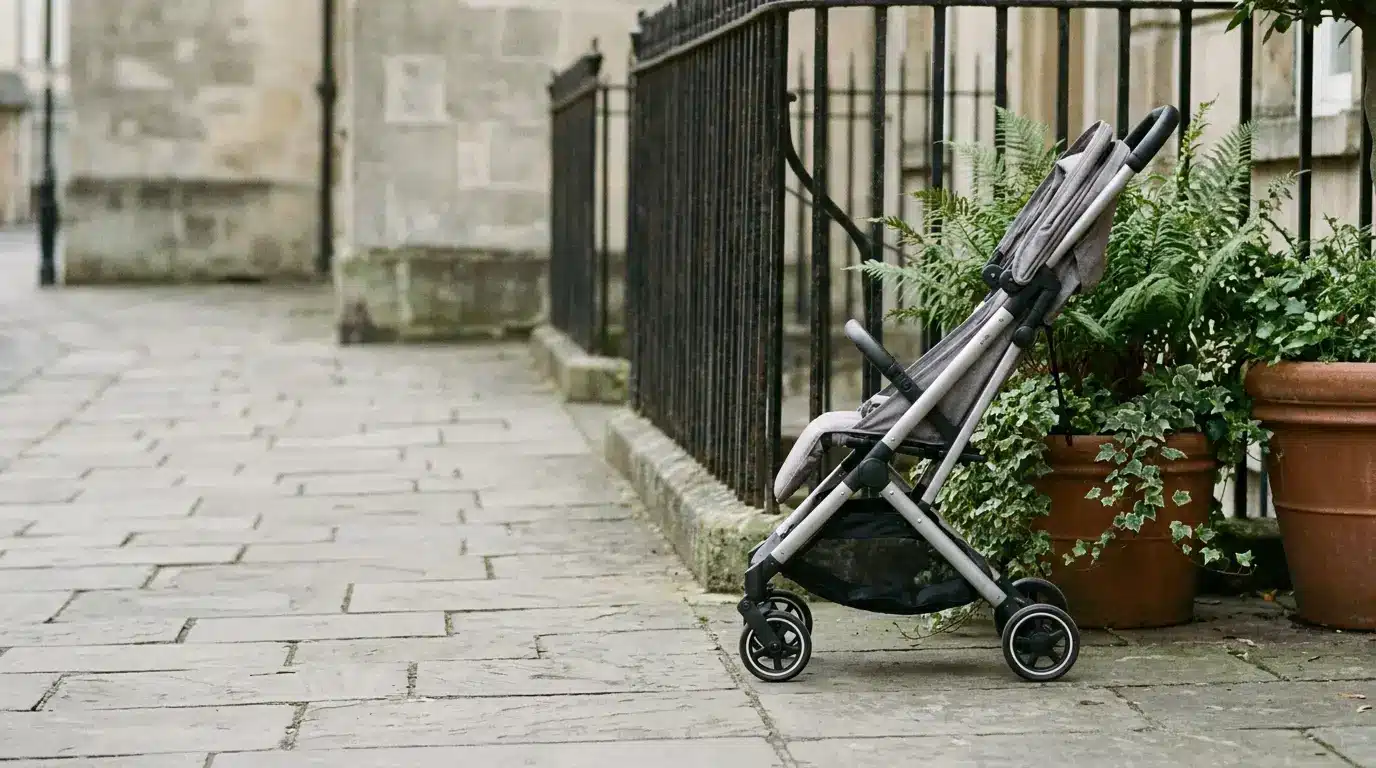
Because no single family routine is identical, selecting mobility equipment requires evaluating daily habits, living spaces, and transit preferences.
High-Density Urban Living
Parents living in metropolitan areas face unique environmental constraints, including narrow doorways, apartment stairs, tight elevator spaces, and frequent public transportation use.
- Minimalist Footprints: Compact, streamlined frame widths allow smooth navigation through crowded cafes and tight grocery store aisles.
- Single-Hand Folding Mechanisms: The ability to collapse equipment quickly with one hand while holding a child or managing luggage with the other is indispensable when boarding buses or climbing staircases.
Long-Distance Travel and Frequent Flying
For families who travel regularly by air or train, gear weight and folded dimensions become top priorities.
- Cabin Overhead Compatibility: Ultra-compact folding systems designed to collapse down to international airline carry-on dimensions eliminate the need to gate-check gear, reducing the risk of transit damage or lost luggage.
- Lightweight Materials: Structural frames constructed from aircraft-grade aluminum alloys or carbon fiber minimize total weight without compromising structural strength or load-bearing capacities.
Suburban and Outdoor Exploration
For families residing in suburban areas with access to parks, trails, and large vehicle trunks, weight is often secondary to storage capacity and rugged performance.
- Expansive Under-Seat Storage: Deep, accessible cargo baskets hold heavy diaper bags, jackets, picnic supplies, or grocery items easily.
- Multi-Terrain Adaptability: Larger wheel diameters and locking front swivel wheels allow caregivers to transition seamlessly from smooth pavement to sand, gravel, or packed dirt trails.
Best Practices for Maintenance, Hygiene, and Storage
Proper maintenance preserves safety standards, extends equipment longevity, and maintains a clean environment for delicate infant skin.
Fabric Care and Sanitization
Children regularly drop food crumbs, spill liquids, and track dirt onto seating surfaces.
- Routine Vacuuming: Use a brush attachment to remove dry debris from fabric seams, buckle pockets, and folding hinges where grit can collect.
- Targeted Spot Cleaning: Clean fabric panels using warm water and mild, non-toxic baby detergent. Avoid harsh chemical bleach, which can degrade flame-retardant fabric coatings and irritate sensitive skin.
- Machine Washing: When seat covers are fully removable, wash them on a gentle cycle in cold water and air-dry thoroughly to prevent fabric shrinkage.
Chassis and Wheel Care
- Debris Clearance: Inspect wheel axles regularly to remove wound hair, string, or packed mud that can restrict rotation and wear down internal bearings.
- Silicone Lubrication: Apply a dry silicone lubricant spray to wheel axles and folding joints periodically. Avoid oil-based lubricants like WD-40, which attract dust and create a sticky grime buildup over time.
- Moisture Prevention: After exposure to rain, snow, or beach sand, rinse metal frames with fresh water and wipe them completely dry with a soft cloth to prevent rust and surface corrosion.
Final Thoughts
Navigating family life with an infant requires gear that balances child health, mechanical safety, and daily convenience. By prioritizing flat recline options, ergonomic hip support, reliable braking systems, and lightweight portability, parents can make informed choices that fit their unique lifestyle. With the right setup, families can step out with confidence, knowing their child is safe, comfortable, and ready to explore the world together.